
 menu
menu"caring for cats"

Electronic Containment Fences
Electronic Containment Fence systems were originally designed to confine dogs to certain areas by transmitting a radio signal from a thin boundary wire to a receiver on the dog’s collar. When the animal approaches the boundary wire a high pitched audible beep warns him/her to retreat, and if the warning is ignored, and the pet goes closer to the boundary wire, an electrical stimulus (called by some a ‘shock’) is transmitted through the collar. A training programme using flags is usually provided by the better suppliers. Some of these containment fence systems were then adapted so that they could be used to keep our cats safe as well.
The idea of giving a shock (no matter how mild) to one of our lovely feline companions was a rather frightening idea. However, imagining the horrific pain suffered by a cat under the wheels of a car, and knowing the terrible anguish attendant with the loss of a dearly loved cat , it was clear that we needed to investigate these fences. Having discussed the principle with a vet, who had already installed an electric containment fence, and knowing that there were different types of these fences on the market, we chose, in June 2009, to use just one of those available. We would therefore stress that our results and comments are limited to one product.
We originally sought to contain just two cats within the garden. One was a ten year old tabby who had never shown a tendency towards becoming a member of MENSA. The other was a very bright nine month old kitten. Both cats loved to be outside in the garden. Sadly, neither of these two adorable little friends is still with us today (in 2025) as we update this website page.
The Boundary
The boundaries of the gardens vary considerably, and this was actually a useful factor when considering the installation of the fence in different types of properties. The various features include: stone walling, wooden fencing, entrance gates across tarmacadam, tree trunks, lawn, hedges and shrub beds.
The tester initially chose to have the hidden fence installed on just three quarters of the boundary because the remainder of it was open to a field, and a long way from the main road.
Installation
The installation was, despite the varied physical features, far easier than was expected.
Where tree trunks were close to a wall or a fence, the installer simply attached the wire to the wall and fence.
Where there was lawn, his machine cut a narrow (virtually invisible) channel into which the wire was buried some 3 to 4 inches below the surface.
The same fine line was cut into the tarmacadam and the wire inserted. “Invisible” is an appropriate word, and the tester’s fear of having to rectify damage to her lovely gardens was proved to be unfounded.
Small temporary flags were then placed around the garden some 3 to 4 feet from the wire.

Receivers
The first generation of receivers (shown in the photographs below) would not appear ungainly on a dog; but on a small cat they looked huge. Having said that, neither of the two cats involved, both of whom were accustomed to wearing ordinary cat collars, seemed in the slightest bit uncomfortable wearing the receivers.
Important Reminder: It is extremely important to check the batteries in the receivers on a regular basis. Ask the supplier of your particular containment fence for his advice on the average life of the batteries, and either check them prior to the anticipated end date, or make a note in your diary to change them then anyway. There will always be some of our feline rascals whose curiosity will keep tempting them towards the road, and they need to be reminded of the boundary by the warning beep from the collar…… this ‘beep’ is, of course, powered by the battery.

Due to lobbying from ourselves and others, the manufacturers of the particular containment fence which we tested, and others, have now produced a smaller receiver for cats. It is at least a third smaller than the earlier ones, and is significantly lighter. Whilst there was no obvious expression of gratitude from our cats when the receivers were changed, to the human eye they were certainly a huge improvement – and appeared far more suitable for our feline friends.
Training
A spare room in the house was used for training the two cats. A part of the room was set up with an operational “fence”, and flags positioned a couple of feet away. Food was then placed within the containment area.
The “not-very-bright-tabby” slowed in his gallop towards the food as soon as the little warning beep on his collar sounded.
Approaching the flags more cautiously he then experienced the electrical stimulus (or mild static ‘shock’) and decided that he was not hungry after all!
The supposedly bright little 9 months old kitten was not so wise. However, having tried to attack the food from three different directions she promptly scuttled away under a chair.
Although a few days of this training was recommended, neither cat was interested in returning anywhere near the flags again, so it was time to let them into the garden.
Results
The kitten saw the flags a few moments after exiting the cat flap and simply changed direction towards a different part of the garden. Some weeks later she was happily confining her antics away from the boundary wire.
The tabby was a different story altogether. Within 24 hours he had gone missing!
The search party found him sitting comfortably outside the entrance gates with a look on his face which appeared to say: “What took you so long?”. The cat which we had thought to be not-so-bright had found his way through the open field and had then skirted 14 houses along the main road to eventually position himself some six inches away from the flags at the main entrance. He knew that it was time for dinner!
No surprise therefore that the fence was extended to include some of the field and hence provide one hundred percent cover of the containment area.
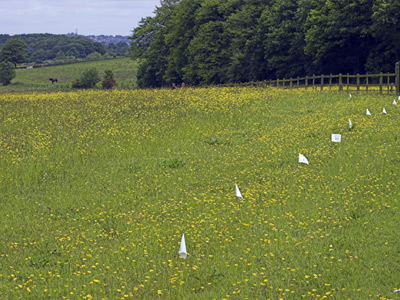
Flags
The flags are a temporary measure. They are slowly removed as the pet becomes accustomed to the contained area within which he/she can play and also to the warning beep which he/she hears if venturing too close to the boundary.
Opinion
Despite her initial concerns, the tester was, and still – in 2025 – is delighted with the “hidden fence” method of containment by DogFence www.dogfence.co.uk Another large supplier with an excellent reputation is Freedom Fence www.freedom-fence.co.uk
Both cats appeared to be as happy and mischievous as they ever were, and they didn’t go near that main road!
Recommendation
Feline Friends recommends that cat owners who live in the proximity of a public road, whose cats are allowed outside to roam freely, and particularly those with large gardens, consider the installation of an electronic containment fence if their furry companions cannot otherwise be prevented from wandering onto a road by conventional fences or enclosures. Too many of us delay until after we have suffered the bereavement of a dearly loved friend before we take action.
Anecdote
The cats in our test were more quickly trained than their owner. The habit of worrying where they were took a long time to break. Now, with 5 cats, and living in the same house, the tester is much more relaxed about their whereabouts. Never-the-less they are all kept indoors at night (and their collars removed for the night).
Note: As mentioned earlier, there are a number of companies selling similar products, and Feline Friends has only tested one of them.
The Controversy
In Wales, all E-Collars have been banned, this is regardless of their type and the systems to which their use is applied.
In England the Department for Environment, Food and Rural Affairs (Defra) commissioned a major scientific research study by the University of Lincoln into E-Collars when used for training dogs. This particular use involves hand held remote controlled devices operated by the pet owner/s. The research showed no evidence that E-Collars caused long-term harm to dogs’ welfare, and therefore no ban was imposed in England. Defra further confirmed that there were no proposals to place restrictions on the use of electronic containment.
Feline Friends acknowledges that an outright and all-encompassing ban in Wales was far easier for civil servants and organisations such as the RSPCA (which opposes the use of all and any E-Collars) to administer. However, we know from our own experience (and that of countless other cat owners) that E-Collars used with containment fences save our cats from agonising death or horrific injury on the roads. Furthermore, ‘contained’ cats do not defecate in other people’s gardens, and cannot be poisoned by whatever they might find during their wanderings away from the safety of their homes. The use of these systems has certainly demonstrated to us that they are currently the best way of protecting those of our much-loved feline companions who enjoy the freedom of an outside life, but who cannot be contained within their gardens by conventional fences and walls, or by special enclosures.
Whilst the research for Defra was being undertaken there was considerable concern amongst countless pet owners that England might follow the Welsh example and also ban E-Collars. Feline Friends therefore made the film below as part of a campaign to prevent this from happening. Despite the fact that a threat of a ban no longer exists, we are leaving the film on our website so that those cat owners interested in this particular method of containment might find out more about it.
Please watch this film
Please note that the link to our Petition (as shown on the film) is no longer available
Scientific Research
As seekers of knowledge to improve the welfare of cats, and because of the practical experience gained from using an electronic containment fence ourselves, the Trustees of Feline Friends decided it wise to sponsor a scientific research project into the welfare aspects of cat confinement by electronic containment fences. The obvious choice of research team was The University of Lincoln which had been selected by the UK Government to undertake the study into electronic collars for dogs.
The background to this, and the results (published in September 2016) can be found under ‘Containment Fence Research‘.
Photography: www.gbcproductions.co.uk
October 2025General
"It is in the nature of cats to do a certain amount of unescorted roaming"
Adlai Stevenson