
 menu
menu"caring for cats"

Containment Fence Research
New Study Aims To Examine The Welfare Aspects Of Cat Confinement
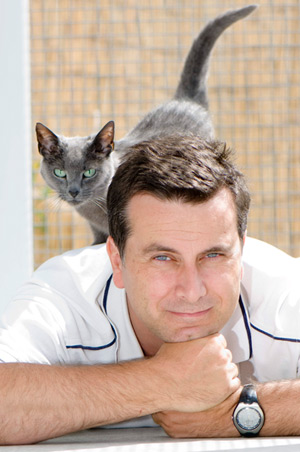
Professor Daniel S. Mills BVSc PhD CBiol FIBiol FHEA CCAB Dip ECVBM-CA MRCVS
The University of Lincoln
Where it all Started – September 2011
Cats are well known for their tendency to wander. This can lead them into all sorts of trouble, from straying onto roads (an estimated 250-300,000 cats are run over on the UK’s roads annually) to upsetting neighbours. It is, therefore, important that they are confined in a safe and humane way that doesn’t compromise their welfare. However, this may not be as straightforward as it seems because it may not always be possible to cat-proof properties with physical barriers. One option is simply to keep cats indoors, but this may itself be stressful, as is apparent in the association between indoor-only status and a number of recurrent diseases, such as a form of stress related bladder inflammation.
An alternative is to use an electronic containment system. This works by teaching the cat to learn a simple avoidance behaviour in response to a visual marker and an audible stimulus that sounds when they approach the defined boundary of a property. If the cat ignores these warnings it will receive an electric pulse (“shock”).
The use of this method of containment is a source of debate between different groups who all care passionately about the quality of life of domestic cats. Unfortunately, in the absence of any research, this debate has been founded on opinion and anecdote rather than fact. Some people have expressed concern over the use of electronic containment systems, while others are equally concerned over the risks posed to the wellbeing of cats that are not effectively confined to safe areas.
The lack of scientific research to inform the debate has lead to a major new project being started under the direction of scientists at the University of Lincoln, following a donation from the charity “Feline Friends (Derbyshire)”. They will be examining the problems associated with different forms of containment as well as the welfare of cats confined by electronic containment systems. Over the course of the next three years, they will be using the latest scientific techniques to assess both the motivations of cats in the garden and their overall welfare state, in order to inject an evidence base into the issue. It is hoped that as a result of this work a more objective opinion can be formed about what is in the cat’s best interests when considering containment.
Prof Daniel S. Mills BVSc PhD CBiol FIBiol FHEA CCAB Dip ECVBM-CA MRCVS
European & RCVS Recognised Specialist in Veterinary Behavioural Medicine
Dept of Biological Sciences
University of Lincoln
Riseholme Park
Lincoln
LN2 2LG
tel +44 1522 835356
e-mail dmills@lincoln.ac.uk
web-page http://staff.lincoln.ac.uk/dmills
The Results – September 2016
We can do no better here than provide the Press Release sent out by the University of Lincoln in September 2016 upon completion of the research:
PRESS RELEASE
No evidence of long-term welfare problems with electronic containment of cats
A study by animal welfare specialists has provided new evidence that using electronic containment systems to restrict where pet cats venture does not result in long-term wellbeing problems.
The use of hand-held shock collars on dogs has previously led to concerns over the welfare of animals trained using so-called ‘e-collars’. However, other forms of electronic training devices for pets have received relatively little attention from researchers. These include invisible or virtual fences which deliver a static electric pulse to deter animals from crossing a boundary, such as a garden perimeter.
A new study into these systems by animal welfare researchers at the University of Lincoln, UK, is the first of its kind. The researchers found no evidence of long-term welfare problems in cats living with these fences, compared to control cats able to roam freely in and out of their owners’ gardens.
Professor Daniel Mills, Professor of Veterinary Behavioural Medicine in the School of Life Sciences at the University of Lincoln, explained: “While some will argue that electronic containment systems can never be justified for pets, others highlight that, in the UK alone, tens of thousands of cats are killed and injured on roads each year and these devices can prevent these often fatal injuries and the emotional cost to the cats and their owners. In contrast, housing cats solely indoors to remove such risks is associated with increased prevalence of a range of health problems including obesity, Feline Urologic Syndrome and dental disease. Long-term exposure to common flame retardants widely used in homes may also have toxic side effects for cats.”
Unlike owner-operated hand-held electronic training devices, invisible fences depend purely on the cat’s behaviour for any correction and not human judgement. Modern devices train the cats to associate a warning beep with the location of the invisible fence. As a consequence animals may be able to quickly and efficiently learn appropriate avoidance behaviours, without persistent anxiety or fear of a shock.
The scientists undertook a range of behaviour tests designed to assess the mood and anxiety of cats and found that, if anything, those contained with electronic boundary systems appeared more confident when it came to new experiences.
The research, which is published in the scientific journal PLOS ONE, was carried out by some of the same scientists whose previous work highlighted welfare concerns relating to the hand-held devices used with dogs.
Dr Naïma Kasbaoui led the research, which was funded by the charity Feline Friends. She said: “This work is an important first step in studying these electronic containment systems. All of the cats involved in our research were well cared for and those that were contained with the electronic fencing had at least 100 square metres of external space available.
“Further work is now needed to explore the effects on cats kept in smaller enclosures, but our results should help reassure many owners looking to keep their cats safe from roads using these containment systems.”
Dr Jonathan Cooper, Principal Lecturer in the University of Lincoln’s School of Life Sciences, added: “Electronic training of animals can be controversial and we know that it can lead to poor welfare when used without a good understanding of pet wellbeing and training. However, this new study suggests that with invisible electronic fences, at least, cats can be effectively contained without compromising their quality of life.”

April 2010
General
"Cats do not go for a walk to get somewhere, but to explore"
Sidney Denham