
 menu
menu"caring for cats"
Chronic Kidney Disease (CKD)
Sarah M. A. Caney BVSc PhD DSAM(Feline) MRCVS
RCVS Specialist in Feline Medicine
What is chronic kidney disease?
Chronic kidney disease (CKD) is an irreversible and progressive condition in which kidney function has deteriorated such that normal excretory (and other) functions are no longer adequately done. CKD is a leading causes of illness and death in our older cats; it is estimated to affect more than a third of cats aged 11 years and over. Kidney disease can also affect younger cats, for example due to congenital diseases of the kidneys (diseases present from birth) or exposure to toxins. It is of paramount importance that owners of older cats remain vigilant for the early signs of this progressive disease, especially since advances in care now mean that many diagnosed cats can live for several years with appropriate management. The best outcome is with early treatment of CKD.
What causes CKD?
There are a wide range of known causes of kidney damage, but in most cats diagnosed with this condition, the cause cannot be determined. Known causes include:
- Congenital conditions (present from birth) including abnormal development of the kidney/s such as polycystic kidney disease
- Acquired conditions including
- Bacterial, viral and occasionally parasitic infections
- Exposure to toxins such as lilies, antifreeze and certain medications
- Inflammatory conditions affecting the kidneys
- Relating to obstruction of ureters/urethra (preventing elimination of urine)
- Tumours of the kidneys or ureters
- Damage to the kidneys caused by high blood pressure
- Damage to the kidneys following dehydration/problems with blood flow to the kidneys
If an underlying cause of the CKD is found, specific treatment of this (where possible) is recommended to prevent further damage to the kidneys.
How can carers spot CKD in their cat?
In most cats with CKD, the disease progresses slowly and it can be difficult for carers to spot signs of ill health as these can be quite vague.
Most typically your cat will start to drink more water and to urinate more frequently and in larger quantities. A poor appetite and weight loss are common, with signs of lethargy and/or vomiting as well. Affected cats may have poor coat condition, some have bad breath (uraemic halitosis) and many cats with advanced kidney disease suffer from constipation. Sometimes just a change of behaviour such as being less sociable or hiding away more is noticed.
Although these clinical signs can often be caused by many less serious health problems, it is extremely important to take your feline companion to the vet as soon as you notice any of these signs. At this stage, it is sometimes (but not always) possible to stop or at least slow down the disease process.
How is CKD diagnosed?
The clinical history (what you tell your vet about your cat’s behaviour and health at home) and a thorough physical examination can reveal some clues of CKD. For example, typically the history includes some weight loss and an increased thirst.
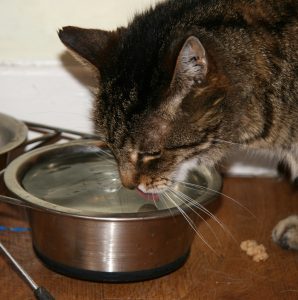
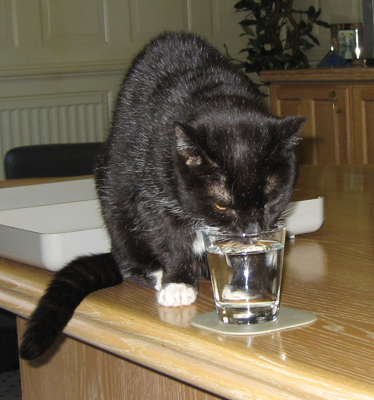
1. Increased thirst is often noticed in cats with CKD
Physical examination of a cat with CKD can be completely normal but clues of CKD include pallor (evidence of anaemia), dehydration, systemic hypertension (high blood pressure) and abnormal feeling kidneys (often small and irregular but can be large or asymmetrical). It is important to emphasise that physical examination may be completely normal in cats with confirmed CKD.
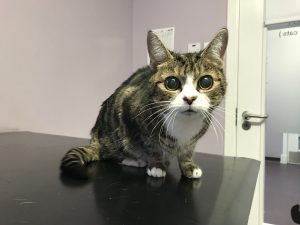
2. High blood pressure can manifest as sudden onset blindness, as in this cat where you can see both pupils are very large and non-responsive to light. Vision may return with treatment of the high blood pressure but better still is routine monitoring of blood pressure in older cats such that it is diagnosed and managed at an earlier stage.
Blood and urine tests are needed to confirm a diagnosis of CKD. CKD is diagnosed in cats that have clinical signs consistent with CKD for several weeks or months, increased blood levels of creatinine and/or SDMA in addition to more dilute urine than is normally produced. Creatinine and SDMA are both excreted by the kidneys and are elevated in dehydrated patients, in cats with ruptured bladders or urethral obstruction (‘blocked cats’) as well as cats with CKD so it is important for your vet to determine whether the elevation in these values is ‘pre-renal’ (eg dehydration), ‘renal’ (eg CKD) or ‘post-renal’ (eg blocked cats). Healthy cats produce very concentrated urine but a drop in the urine specific gravity (USG, the measure of urine concentration) is typically found in cats with CKD as they lose their ability to produce concentrated urine.
Additional tests are often helpful to understand more about the kidney disease and to ‘stage’ the severity of the CKD. For example, renal ultrasound can be helpful in showing clues of a kidney infection (pyelonephritis); assessing blood pressure and proteinuria (amounts of protein present in the urine) is important in Staging the CKD.
How is CKD treated?
There is no cure for CKD. However, there are strategies that are known to slow the progression of disease and regular monitoring also allows identification of complications of CKD for which treatment can benefit quality of life. CKD is considered to be a progressive condition – it will get worse with time although the rate of progression varies considerably between patients. Findings with a negative prognostic association include: renal proteinuria, hyperphosphataemia, anaemia, worse stage of CKD, low albumin and low USG.
Management of CKD aims to:
- Identify and treat any underlying disease which is causing ongoing renal damage e.g. pyelonephritis (kidney infections): treatment of the infection with appropriate antibiotics stops further damage to the kidneys
- Where possible, use strategies that are known or thought to slow the progression of renal disease
- Provide supportive and symptomatic treatments to improve quality of life
Cats with CKD are vulnerable to phosphate retention since the kidneys are responsible for excreting excess levels of this from the body. Phosphate accumulation in the body is an important trigger for a number of harmful pathways that contribute to progression of disease and also make the cat feel more ill. Feeding a phosphate-restricted therapeutic renal diet is the most proven strategy for slowing the progression of disease in cats with CKD so carers should make all efforts to encourage their cat to eat one of these foods. Phosphate binders – substances added to the food that help prevent phosphate from being absorbed – can also help to maintain normal blood phosphate levels.
Common complications of CKD for which symptomatic treatments can make a massive difference to quality of life include:
- Low potassium levels: cats with CKD are vulnerable to low blood potassium levels through losing potassium in their urine and, if their appetite is poor, not eating enough potassium. Low potassium levels contribute to lethargy, weakness and poor appetite. Potassium supplements and feeding a renal therapeutic diet help to maintain normal potassium levels and are recommended to support affected cats
- Anaemia: cats with advanced CKD may suffer from a gradual decline in the number of red blood cells (anaemia) which can increase their lethargy. Some anaemic cats will show ‘pica’ – an abnormal appetite which can be manifested as eating cat litter or soil, or licking walls or concrete. A number of treatments are now available to stimulate red blood cell production in cats with anaemia due to CKD
- Dehydration: cats with CKD are vulnerable to dehydration and when this occurs it makes their kidney function worse as well as making them feel unwell. Dehydration can be treated (and prevented) in a number of ways including offering palatable liquids to drink, adding extra water to food and administering subcutaneous fluids to your cat at home (under direction of your vet).
- Systemic hypertension (high blood pressure): hypertension can be very damaging to the body, including increasing the risk of progressive kidney damage. Authorised medications that lower the blood pressure are available and are very effective.
- Nausea and vomiting: many cats with CKD suffer from nausea; anti-sickness medications are helpful in cats suffering from this.
- Poor appetite: once all ‘treatable’ causes of poor appetite have been addressed (eg dehydration, low potassium), appetite stimulant medications can be helpful in encouraging eating
- Constipation: ensuring adequate hydration is helpful for CKD cats prone to passing hard and dry faeces. Some cats with CKD benefit from stool softeners such as PEG3350, available from your vet.
- Proteinuria: If proteinuria is present, this can indicate activation of the RAAS – a potentially damaging consequence of CKD that increases the risk of progressive kidney damage and worsening of the CKD. In affected cats, an angiotensin receptor blocker (ARB) or angiotensin converting enzyme inhibitor (ACE inhibitor) might be recommended to suppress the RAAS and reduce proteinuria.
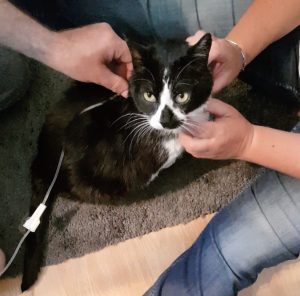
3. Home administration of fluids can be helpful for cats vulnerable to recurrent dehydration and most cats tolerate this well
Other recently available treatments that may help reduce clinical signs of CKD include uraemic toxin binders (eg Renaltec, Porus One). These are dosed orally and work by binding to toxin precursors produced in the bowel and preventing these from being absorbed into the circulation where they would be converted into toxins by the liver.
Check-ups are important to monitor progress and ensure that quality of life is as good as possible. Having a good team-working relationship with your vet helps this. Keeping a diary at home can help inform vet decisions so if you can record the following, it will really help your vet:
- Types and amount of food offered (weighed in grams), amount eaten (in grams)
- Frequency and approximate amount of urine passed each day eg 5 big urinations per day
- Frequency and consistency of faeces passed: passing hard dry faeces infrequently can indicate dehydration
- Thirst – no need to measure precisely but an indication of your cat’s thirst is helpful
- Medications: frequency, route, ease of administration, any challenges or concerns
- Bodyweight: investing in inexpensive ‘baby’ scales can facilitate home monitoring of bodyweight
- If subcutaneous fluids are being administered at home: frequency, volume, hydration status before and after, speed of fluid absorption
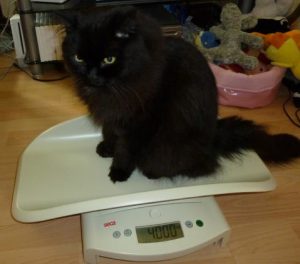
4. Scales can be obtained to allow home monitoring of bodyweight
The rate at which CKD progresses varies markedly from cat to cat, but whether it be in months or years there will come a time when you know that your beloved friend is now suffering despite all your very best efforts. This is a truly devastating time, and you have probably grown even closer to your little companion during the period of his or her illness. Never-the-less, your love must now be demonstrated to the fullest extent possible, no matter how heartbreaking it is for you. Your cat is relying entirely upon you to repay his or her love by bringing a prompt end to the suffering by asking your vet to give that final injection which will send your playmate to a place that is free of pain.
Cotton Socks
20.04.1989 – 12.01.2008
A wonderful friend who fought CRF so bravely – Caroline Fawcett
Feline Ailments
"I believe cats to be spirits come to earth. A cat, I am sure, could walk on a cloud and not come through."
Jules Verne